Launching your vacation rental business in Dubai 2026: 12 key steps for success in short-term property rentals
Launching your vacation rental business in Dubai 2026: 12 key steps for success in short-term property rentals
From licensing to listing — navigating Dubai’s vacation rental landscape with compliance and smart marketing
Vincy Amirtharaj
58 post
Senior Business Setup Consultant, Dubai
The short-term rental market in Dubai has experienced rapid growth following the post-pandemic travel surge. It has now become a highly attractive investment option that offers considerably greater returns than traditional long-term leasing. As tourism in Dubai continues to reach all-time highs, the demand for luxury vacation rentals in prime areas of Dubai such as Downtown, Dubai Marina and Palm Jumeirah continue to outpace available supply. This creates a compelling opportunity for investors to achieve high rental yields.
However, launching a successful business in Dubai involves more than simply listing a property on Airbnb. For long-term sustainability, there are specific DET regulations (Dubai's Department of Economy & Tourism) that need to be followed and the appropriate holiday home operator licence needs to be secured. To run a successful rental property portfolio (whether as a direct landlord or a third-party intermediary or Airbnb management) it is very important to understand what laws govern your business. This will help prevent fines from being issued and will allow you to be compliant and continue operating successfully.
We simplify the process of setting up your business in Dubai by clearly mapping out all the required steps. This includes understanding vacation rental business setup costs, obtaining your final unit permits and complying with the Tourism Dirham fee structure. Read on to learn how to start a vacation rental business in Dubai and turn your hospitality vision into a profitable reality that is fully compliant by 2026.
Typical 8-week setup timeline
Week
Authority / Task
Key output
1
DET/ Free Zone
Initial approval ✓ | Trade Name Reservation Certificate ✓
2
Land Dept / Ejari
Office lease signing → Ejari registration
3
DET/ Free Zone
Commercial License Payment & Issuance ✓
4
DET’s Holiday Homes portal
Holiday Homes Operator registration approved ✓
5
Bank
KYC review → Corporate Account opening
6
GDRFA
Investor / Staff visas stamped
7
Unit Onboarding
Furnishing check & insurance procurement
8
DET portal
Unit Permit Generation (QR Code) - Go live!
Note: While the license itself (Weeks 1-3) is fast, the DET Holiday Home Operator registration and bank account opening (Weeks 4-5) are crucial compliance steps before you can market properties.
"DET is committed to realising a leadership vision that aims to build an unparalleled future for our city, aligned with the Dubai Economic Agenda, D33. This ambitious 10-year plan is set to double Dubai's GDP, elevate its status to be among the top three global cities, and achieve the vision of making Dubai the foremost city to visit, live and work in and invest."
- His Excellency Helal Saeed Almarri, Director General, DET
Select the activity scope that matches your business goals:
Full Management (Operator)
End-to-end management, guest relations, cleaning & listing under your license.
Rent-to-Rent Model
Leasing units long-term on your name and re-letting them as short-term stays.
Marketing Partner
Managing digital listings (Airbnb/Booking) while the owner holds the permit.
Concierge Services
Add-ons like airport transfers, welcome packs, and excursions (require separate license).
Property Maintenance
Specialized cleaning and snagging services for holiday homes.
Investment Advisory
Advising foreign investors on high-yield ROI properties.
Furnishing & Fit-out
Staging units to meet DET standards.
Pro tip
Clarify if you are an "Individual Host" (managing your own unit) or a "Professional Operator" (managing units for others)—the licensing requirements and costs differ significantly.
Step 2: Choose a trade name
Pick a unique name that reflects hospitality or property management, then reserve it with DET. Ensure it doesn't infringe on major hotel brands. Secure the matching domain immediately. During the early stages of business setup in Dubai, securing the matching domain name helps avoid conflicts later in the licensing process.
Quick Fact
From January to June 2025, average occupancy for hotels in Dubai stood at 80.6%, up from 78.7% compared to the same period in 2024.
Source: DET Tourism Performance
Step 3: Draft a hospitality business plan
Target Market
Business travelers (DIFC) vs. Leisure tourists (JBR/Marina).
Budget for high-quality linen and furnishings. DET has strict quality audits, and superior interiors drive higher Average Daily Rates (ADR).
Cost snapshot · 2026
Bank guarantee: No longer required *
DET initial approval: ~AED 120
Trade-name reservation: AED 620
Mainland Holiday Homes license fee: AED 15,000 - 25,000
DTCM Operator Registration: AED 1,520 (approx)
Unit Permit Fee: AED 300 / unit / year
Tourism Dirham: AED 10-15 / night (guest pays)
*The previously required bank guarantee for holiday home operators was waived to encourage market entry, though some free zones may still request a deposit.
Setup-cost estimator (AED)
Estimated setup cost: —
Get detailed breakdown on WhatsApp
*Includes AED 740 for initial approval (120) + trade-name reservation (620).
DTCM permit fees per unit and office rent vary—chat with us for an exact quote.
Step 4: Select a business structure
Pick the vehicle that fits your portfolio size & liability appetite:
LLC (Mainland)
Best for professional operators managing 3rd-party units. Visa allocation is scalable.
Individual Operator
Ideal for individuals managing only their own properties.
Free Zone FZ-LLC
100% foreign ownership—great for headquarters or holding companies.
Branch office
Extend an existing international hospitality brand into Dubai.
Pro tip
DET requires a "No Objection Certificate" (NOC) from the developer or building management for every unit you onboard.
Ready to turn your vacation rental business plan into action?
Get clear next steps tailored to your situation for successful vacation rental business setup in Dubai.
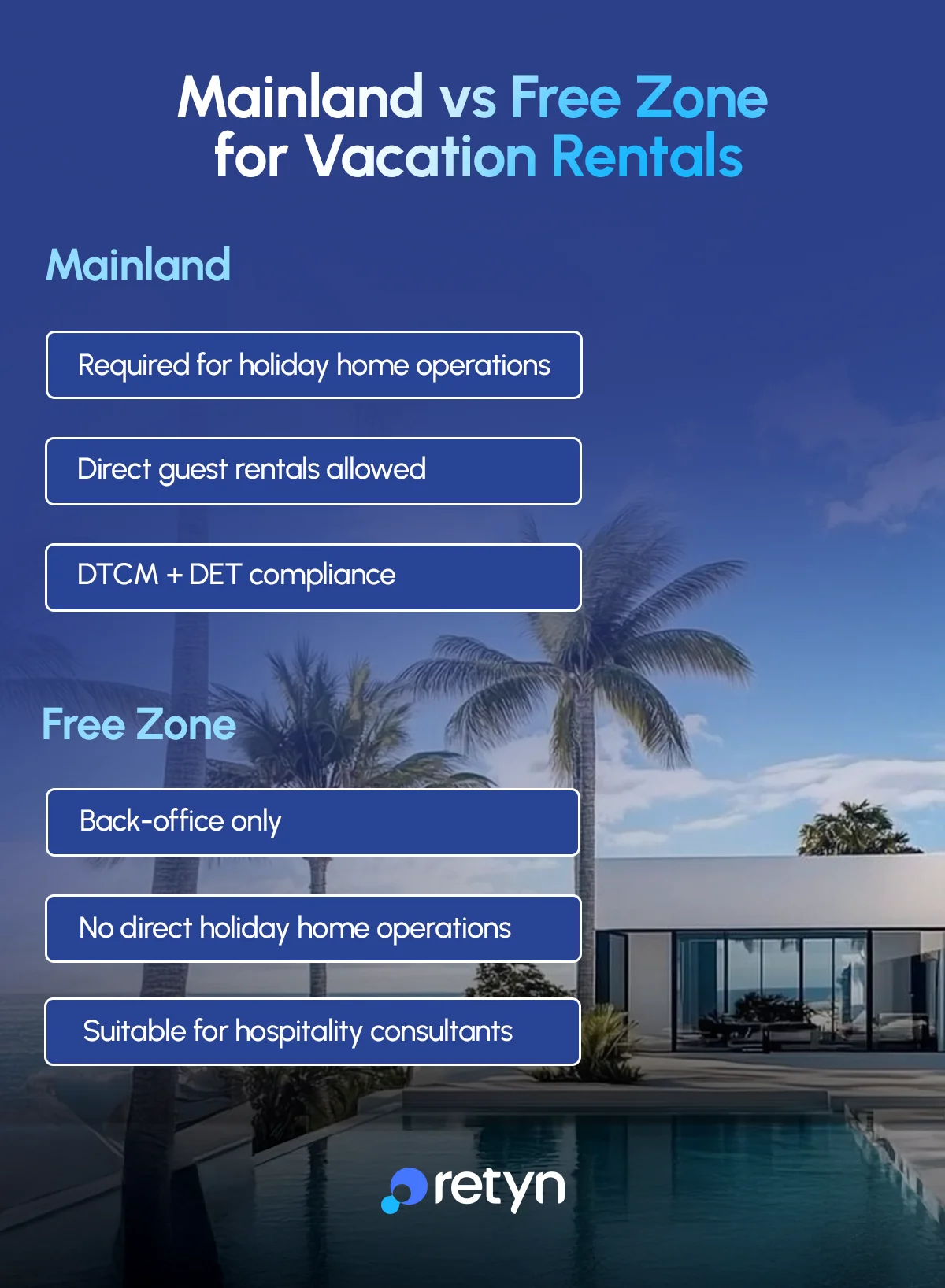
Select the zone that aligns with your property portfolio location and client base.
Mainland
The gold standard for operators. Choosing mainland company formation in Dubai allows you to lease and manage properties anywhere in Dubai (Marina, Downtown, Palm) without restriction.
Requires a physical office for DET approval.
Key requirements:
DET Holiday Home Operator Registration
Mandatory registration with the Department of Economy & Tourism.
Ejari Office Registration
Physical office space (min 200 sq ft) required for the license.
Public Liability Insurance
Cover for guest accidents and property damage in all managed units.
Free zones
100% foreign ownership and cost-effective for holding companies or marketing agencies. However, strictly operating holiday homes often requires a mainland license to interface directly with DET systems for unit permitting. Many entrepreneurs opt for free zone company formation in Dubai due to the streamlined setup, but a DET "Temporary Permit" is needed if they plan to manage units outside the zone’s boundaries.
Ideal for:
Marketing Agencies
Companies that market listings but do not lease the units directly.
In November 2025, the median daily asking price for short-term rentals stood at Dh780, compared with Dh670 during the same period last year. Weekly asking prices rose to Dh5,000, up from Dh4,500 year-on-year, while monthly rates remained stable at Dh16,000.
Source: Property Finder
Step 6: Register & obtain a holiday homes license
Submit forms, secure your trade license and complete Holiday Homes Operator registration through DET’s Holiday Homes system.
Mainland Process
Commercial License Issuance
Finalize the license with DET (Department of Economy & Tourism).
Office Lease (Ejari)
Mandatory physical office (min 200 sq ft) registered with the Land Department.
Holiday Home Operator Registration
Apply for the "Holiday Home Operator" certificate on the DET’s Holiday Homes system after trade license issuance.
Free Zone Process
License Application
Submit documents to authorities like DWC or IFZA.
"Temporary Permit" from the DET
Obtain a Free Zone Mainland Operating Permit to manage properties in mainland.
Listing Platforms
Register on Airbnb/Booking.com using your DET license.
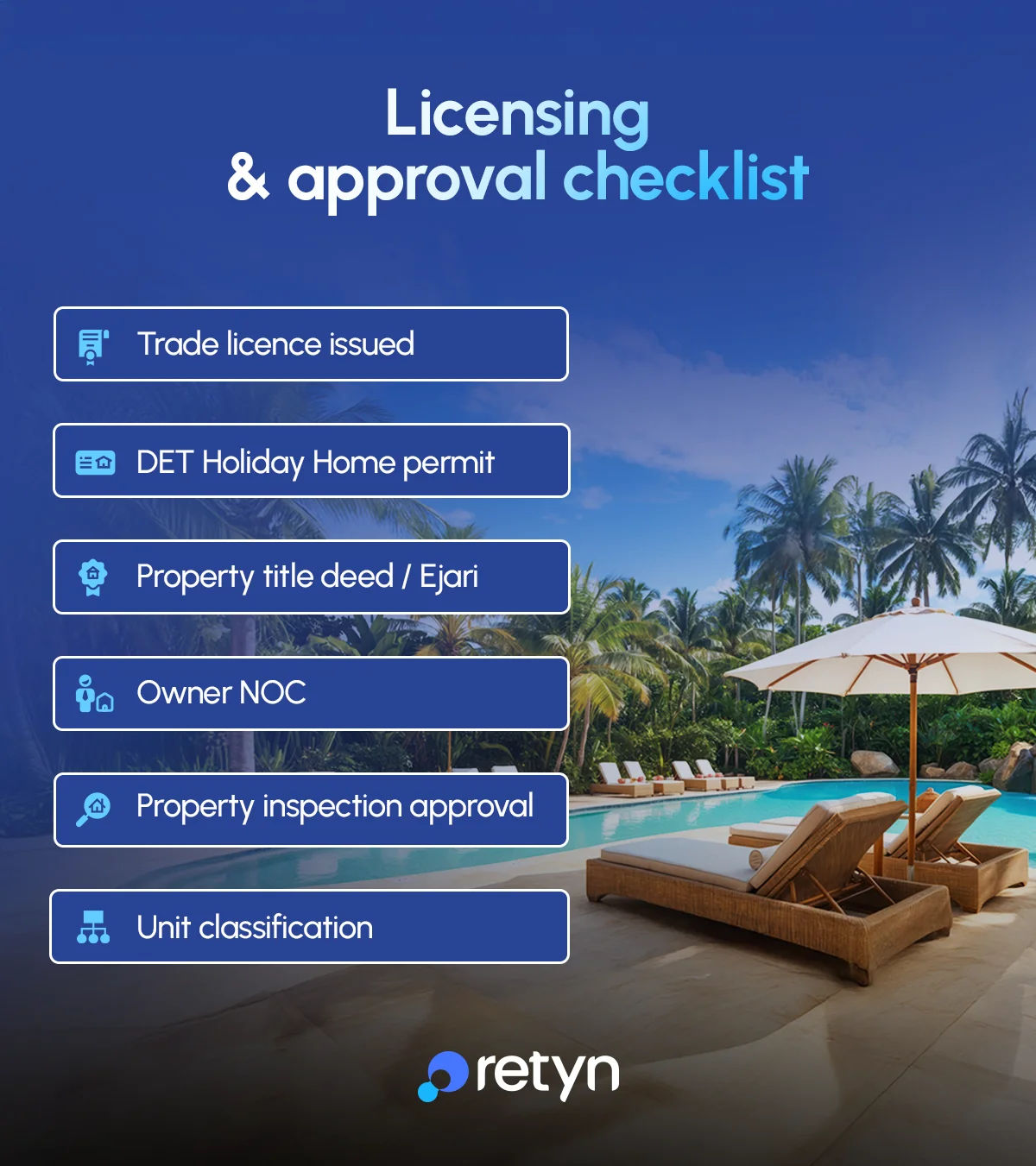
License-application document checklist
Mainland LLC / Operator
Passport & UAE entry stamp (all shareholders)
Emirates ID (if resident)
Office lease / Ejari certificate (Mandatory)
Trade Name Reservation Certificate
Initial Approval Certificate
Memorandum of Association (MoA)
Passport size photos (white background)
DTCM Registration (Post-License)
Copy of valid Trade License
Commercial Register (mainland)
Ejari Certificate (proof of office)
Manager's passport & Visa copy
Contact details (24/7 emergency number)
Public Liability Insurance Certificate
Manager's Emirates ID
Tip: Ensure your trade license activity explicitly states "Holiday Homes Rental" to avoid rejection by the DTCM portal.
sequenceDiagram
participant Founder
participant DET as DET (Economy)
participant LandDept as Land Dept
participant DTCM as DTCM (Tourism)
participant Bank
participant GDRFA
participant Portals as Airbnb/Booking
Founder->>Founder: 1 · Define Model
Founder->>DET: 2 · Reserve Trade Name
Founder->>DET: 3 · Initial Approval
Founder->>LandDept: 4 · Sign Office Lease (Ejari)
LandDept-->>Founder: Ejari Issued
Founder->>DET: 5 · Pay & Issue Trade License
DET-->>Founder: License Issued
Founder->>DTCM: 6 · Register as Operator
DTCM-->>Founder: Operator Certificate Issued
Founder->>GDRFA: 7 · Investor & Staff Visas
Founder->>Bank: 8 · Open Corporate Account
Founder->>DTCM: 9 · Permit Individual Units
DTCM-->>Founder: Unit QR Code / Permit
Founder->>Portals: 10 · Go Live (List Property)
Note over Founder: 11 · Monthly Tourism Dirham remittance
Obtain your establishment card, register for WPS (Wage Protection System), and secure mandatory health insurance. Your property maintenance and cleaning staff will need visas under your sponsorship. To ensure these documents are handled accurately and without delay, many operators utilize professional visa processing services in the UAE.
Pro tip
Housekeeping staff may require specific "Occupational Health Cards" from the Dubai Health Authority (DHA) depending on their exact job title.
Get tailored guidance for your vacation rental business plan
If you’re unsure about the right business structure or permits, a focused consultation can help you assess feasibility and next steps with confidence.
Provide your Trade License, DET Holiday Home Operator Certificate , office lease, and a business plan projecting occupancy rates. Airbnb/Booking.com payouts require a valid AED IBAN in the company's name.
Trade license
Mainland or Free Zone license document.
Cash-flow forecast
Estimated ADR (Average Daily Rate) and occupancy projections.
Landlord Agreements
Sample Management Agreements (SMA) with property owners.
Before you can market a property, every single unit needs its own permit and QR code. This process is fully digital via the DET Holiday Homes portal.
Title Deed & Owner Passport
Proof of ownership from the landlord.
Developer NOC
No Objection Certificate from building management (required in some master communities).
Management Agreement
Signed contract between you (Operator) and the Landlord.
DEWA Bill
Recent electricity bill for the unit.
Once approved, you must display the Holiday Homes permits at the entrance of the holiday home. Failure to do so attracts fines.
Step 10: Arrange insurance & guarantees
Maintain public liability insurance (covering guest accidents), property all-risk insurance (contents), and cyber insurance if you process direct credit card payments.
Step 11: Stay compliant—Tourism Dirham & Taxes
Log these monthly and annual tasks to avoid penalties: Understanding these recurring obligations is an essential part of the process of starting a business in Dubai to ensure long-term stability.
Tourism Dirham Fee (TD)
Collect AED 10 (Standard) or AED 15 (Deluxe) per night/bedroom. Remit to DET by the 15th of the following month.
Insurance renewal
Public Liability & Property Content cover.
Corporate Tax (CT)
9% tax on net profits > AED 375,000. Annual filing required.
VAT returns
5% VAT on service fees (if revenue ≥ AED 375k).
Unit Permit Renewals
Annual renewal of each unit's DET permit (AED 300/unit).
Classification Audits
Ensure units maintain "Standard" or "Deluxe" criteria for surprise inspections.
Pro tip
Automate your "Tourism Dirham" calculations. Late remittance blocks your access to the DTCM portal, freezing new bookings.
Free 2026 Holiday Homes Compliance Calendar (Excel)
Never miss Tourism Dirham deadlines, license renewals, or VAT filings again. Tap below and we'll WhatsApp the Excel sheet instantly.
"Qibla" direction, Emergency numbers, "No Smoking" signs, Community rules.
Housekeeping
Regular cleaning schedule and deep clean between stays.
Guest Registration
Guest details must be registered promptly through the DET Holiday Homes system.
Pro tip
Create a "Digital Welcome Book" for guests. Including instructional videos for AC, appliances, and community gate codes reduces guest complaints by 40%.
Expert insight: The shift from "Passive Hosting" to "Active Hospitality"
Five macro trends are defining Dubai’s short-term rental market from 2026 through 2028, including hyper-niche positioning, AI-driven dynamic pricing, direct-to-consumer booking strategies, PropTech and IoT automation and ancillary revenue monetization. Entrepreneurs who treat their portfolios as a decentralized 5-star hotel experience rather than simply as "furnished apartments", are positioned to generate higher returns than those relying on traditional passively listed Airbnb offerings.
The hotel industry is rapidly maturing in Dubai. The number of entrants competing against well-established hotel brands and professional hotel companies is increasing. New entrants will have to leverage technology to lower their operational costs, while enhancing the quality of the guest experience through premiumization. Simply offering a place for guests to rest is no longer sufficient. Instead, operators must deliver complete experience or lifestyle.
The following five strategies help new licence holders to maximize revenue from high-net-worth tourists visiting JBR, Downtown and Palm Jumeirah. These strategies go beyond providing standard furnishings and basic guest services.
Hyper-Niche Positioning
Do not simply label a property as a "Luxury Apartment." Instead identify and target a specific guest avatar such as remote-work-ready apartments with multi-monitor desk setups or family sanctuaries offering baby-proofing and stroller rentals.
Direct Booking Infrastructure
Commission rates on OTAs such as Airbnb and Booking.com range from 15-20%. Commissions charged by OTAs can be detrimental to your profit margin as you grow your holiday home portfolio. As operators scale their businesses in Dubai, it is common to start investing in a branded website along with an integrated booking engine to complement OTA distribution channels.
Direct bookings with a guest are something that happens over time based on the amount of exposure and repeat guests. The costs associated with direct bookings include maintaining your website, payment gateway fees and marketing efforts. Maintaining a balance between Direct Bookings (DB) and Online Travel Agency (OTA) bookings helps maximize profit margins, as well as comply with the DET holiday home regulations.
PropTech & IoT Automation
Install smart noise sensors like Minut that can detect unusual noise levels in real time, allowing operators to intervene before violations escalate into fines while remaining compliant with guest privacy requirements.
Smart thermostats can be integrated with booking data to automatically shut off air conditioning after guest checkout. This will help reducing unnecessary cooling expenses and lower DEWA bills in high-turnover units.
Ancillary Revenue Streams
Monetize the guest experience beyond the room rate, by offering value-added services such as airport transfer, desert safaris or private chef experiences through licenced third-party providers.
Professional property managers can generate meaningful ancillary income through concierge commissions from group bookings and high-end properties. These commissions range from a few hundred dirhams per booking, but there is an opportunity to earn higher in the luxury segment.
AI Dynamic Pricing
Static pricing can result in missed opportunities for increased revenue. Use dynamic pricing tools such as PriceLabs or Beyond which are capable of adjusting rates based on the largest and most frequent Dubai events, such as GITEX, Formula 1 and New Year's Eve.
A real-time yield management system allows you to capture demand peaks automatically without having to manually make changes.
Pro tip
Build a Guest Data Platform (CDP) early. Collecting emails allows you to run "Return Guest" campaigns (e.g., 10% off for next winter) bypassing OTA fees entirely.
Decision snapshot – what to choose, at a glance
Structure / License
100 % foreign ownership
Manage 3rd Party Units*
Setup speed
Bank-account ease**
Office rule
Mainland "Holiday Homes Operator"
Yes
✓ (Authorized)
≈ 3-4 weeks
High
Mandatory physical office
Free Zone "Property Management"
Yes
No Marketing only
5-10 days
Medium
Flexi-desk allowed
Sole Est. "Homeowner Host"
Yes
No Own units only
≈ 2 weeks
Medium
Residential address
Mainland "Marketing Services"
Yes
No
≈ 1 week
High
Shared office / Estidama
* "Manage 3rd Party Units" means signing contracts with landlords to list their properties under your permit.
** "Bank-account ease" reflects typical compliance checks: DTCM-regulated entities are viewed favorably by banks but require more documentation.
Risk & penalty matrix – key non-compliance fines
Offence
Fine (AED)
Consequence
Operating a holiday home without a permit
AED 5,000
Unit shutdown & license suspension
Unit is licensed but fail to meet the required terms and conditions
AED 500
Warning on first offence
Conducting an authorised activity outside the Establishment
AED 2,500
Security violation record
Figures are based on DET circulars. Always check latest regulations before budgeting.
Choosing a Free Zone license expecting to manage properties directly (DTCM usually requires Mainland).
Signing a lease for an office that is too small (DTCM mandates ~200 sq ft minimum for operators).
Under-estimating furnishing costs—cheap furniture leads to bad reviews and lower occupancy.
Ignoring VAT registration once revenue hits AED 375k (happens fast with high-value rentals).
Failing to get Developer NOCs in restricted communities like Emaar Beachfront or Palm Jumeirah.
Regulation & News updates · Q4 2025
New "Star Rating" System:
DTCM is rolling out a refined classification system. Operators can now apply for "Luxury" status for villas with private pools, commanding higher nightly rates.
Unified QR Code Portal:
The new digital gateway links DTCM permits directly with Police systems for faster guest registration transparency.
Corporate Tax on Rental Income:
Clarification issued: Rental income for individuals (hosts) may be exempt under personal investment rules, but Licensed Operators are fully subject to 9% Corporate Tax.
Noise Control Regulations:
Stricter enforcement on noise complaints in residential towers. Operators must now provide a 24/7 complaint hotline for neighbors.
Glossary of acronyms
DTCM - Dept. of Tourism & Commerce Marketing
DET - Dept. of Economy & Tourism
ADR - Average Daily Rate
RevPAR - Revenue Per Available Room
PMS - Property Management System
TD - Tourism Dirham
NOC - No Objection Certificate
FAQs on starting a vacation rental business in Dubai
Yes. This is a popular model business model for new entrepreneurs. The process works as follows:
Enter into an annual lease agreement with a landlord.
Obtain a No Objection Certificate (NOC) specifically stating that you are allowed to sublease for use as short-term vacation rentals.
Register the unit under your operator licence.
If you do not have the NOC issued by the landlord, you cannot register the unit with the DET.
Because hospitality businesses experience irregular cash flows, banks generally classify them as high risk. Most applications are rejected if the business does not have an Ejari-registered physical office or if the applicant cannot present a clear business plan outlining projected occupancy rates.
Pro Tip: You can only list a property on websites such as Booking.com or Airbnb using a corporate account (IBAN) in your company name that is also the same name as your trade licence. If you attempt to do this with your personal account, the bank will reject your application and so will the platform.
The main difference between standard and deluxe classifications is how they are treated for ADR (Average Daily Rate) and Tourism Dirham fee purposes. Deluxe rooms are required to meet higher specification standards such as larger square footage, premium features and 24/7 support. As a result, deluxe rooms incur a higher Average Daily Rate (ADR) and a Tourism Dirham fee of AED 15 per night per room. Standard units incur a Tourism Dirham fee of AED 10 per night per room and are subject to less stringent furnishing requirements.
If your taxable revenue exceeds AED 375,000 per year (approximately $102,000) in a financial based on gross booking value, then you are obligated to register for VAT. Once registered, you must charge 5% VAT to all of your rent or service fees. It is important to note that VAT liability is calculated based on gross booking value, not net profit.
Yes, you can sponsor cleaners, drivers and maintenance staff when you get your employment visa through your Mainland Holiday Homes Operator Licence. Housekeeping staff may need an Occupational Health Card issued by the Dubai Health Authority (DHA).
Noise regulations in Dubai are very strict for all holiday homes, especially if they are located in master-planned communities such as Palm Jumeirah, Downtown Dubai and Dubai Marina. Noise regulations are monitored and enforced by the building management or community associations in each area. The building management or community association has the authority to issue warning letters, fines and take further action to the Dubai Department of Economy and Tourism (DET) if there is a repeated or serious complaint about excessive noise. In some cases, the unit's holiday home permit may be suspended or revoked based on excessive noise.
Many operators install privacy compliant noise monitoring devices (i.e. Minut) to monitor decibels while protecting guest's right to privacy. This helps prevent noise related issues prior to receiving a formal complaint.
Tourism Dirham collected from guests must be reported and paid to the DET by the 16th of the following month. If you do not comply with this deadline, then it may result in administrative penalties and restricted access to your Holiday Homes portal. Ongoing non-compliance can also restrict you from registering new guests or processing new unit permits, until all outstanding payments and any fines incurred are settled.
Disclaimer: This content is for information only and not legal advice. Regulations change—always consult a qualified professional.
Need help navigating the DTCM licensing maze?
Book a free consultation with our hospitality setup experts.